
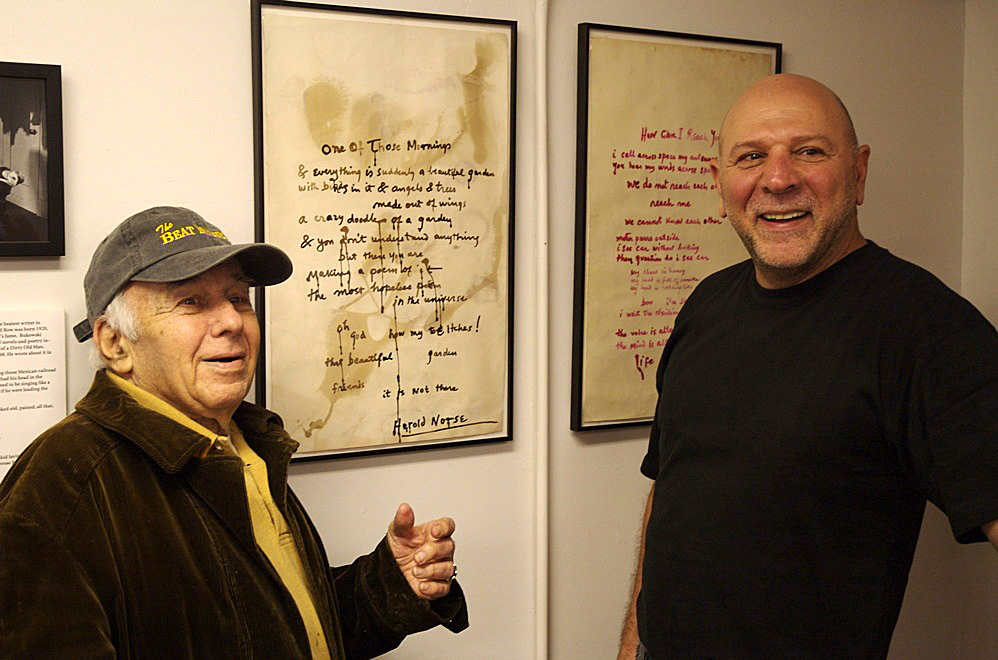
with birds in it & angels & trees
made of wings
a crazy doodle of a garden
& you don't understand anything
but there you are
making a poem of it
the most hopeless poem
in the universe
oh
god how my toe itches!
that beautiful garden
friends
it is not there
- Harold Norse
Norse, whose surname comes from an anagram of his mother's name in Russian, was born in Brooklyn on July 6, 1916. His mother was an unmarried Jewish immigrant from Russia, and though he never knew his father, Norse surmises that he was a German-American soldier. Harold took an interest in literature while in high school, and in 1934 attended Brooklyn College, where he became the first freshman to win the school's annual poetry contest. During his senior year he became aquainted with Chester Kallman, and the two became lovers; though Kallman eventually left Norse for W.H. Auden. Harold graduated from Brooklyn in 1938.
In 1951, Norse's talent was recognized by William Carlos Williams, who invited him to read at the Museum of Modern Art in early 1952. Williams remarked on Norse's ability to "use the direct image on its own," and became an important mentor to Harold. Williams would later call Norse "the best poet of his generation," a profound accolade considering Williams was mentor to such figures as Charles Olson, Denise Levertov, and Allen Ginsberg. Following the 1953 publication of his first book of poety, The Undersea Mountain, which was reviewed in The New York Times and Poetry magazine, Norse left America for Italy. He learned Italian quickly, and took interest in the work of nineteenth-century poet Giuseppe Gioachino Belli, whose over 2000 sonnets he took to translating; a task that had previously defeated both James Joyce and D.H. Lawrence. When translating Belli, Norse also used the services of several street hustlers he knew. Asked how he accomplished the translations, Norse would reply, "With a dictionary in one hand and a Roman in the other."
In 1957, Norse was nearly deported from Italy when the Italian government deemed his poem "Victor Emmanuel Monument (Rome)," published in the Saturday Review, political fodder for the Communists. The poem's last line describes underpaid soldiers or guards at night "picking up extra cash from man and boy." Because the poem had put the editor in a political controversy, Norse was never again published in the Saturday Review.
Also in 1957, Norse's long poem "Florence" was praised by Williams as a masterpiece. He was particularly struck by a section of the poem in which Norse expresses his repugnance at seeing some Renaissance art depicting Classical heroes, "realizing that such lust and madness for power was based on an indomitable will to crush, to destroy—trampling on women."
Norse moved to Paris in 1960, on a tip from Williams, and at the Beat Hotel he met Allen Ginsberg, Gregory Corso, William S. Burroughs, Brion Gysin, and others, drawn by their interest in Buddhist meditation, which Norse had recently taken up. Using the cut-up technique devised by Gysin and Burroughs, Norse wrote his experimental novel, Beat Hotel. Originally titled Sniffing Keyholes, the first chapter—which he describes as "a sex/dope scene between a muscular black youth called Melo and a blond Russian princess called Z.Z."—made even the often stoic Burroughs laugh. During his time at the Beat Hotel, Norse began creating his 'random paintings' or Cosmographs (using the hotel's bidet), which brought the attention of Paris' elite art scene.
Norse's writing began receiving major critical attention during the mid-1960's. A 1966 edition of avant-garde literary journal Ole was devoted to him. Throughout the 1960's, Norse's work appeared in the Evergreen Review, a groundbreaking American literary journal that published the Beats alongside internationally acclaimed experimental writers Samuel Beckett, Günter Grass, and Octavio Paz.
Norse returned to America in 1969 and became involved in the gay liberation movement, settling in San Francisco, where he lives to this day.
Exclusive photographs of Norse and his contemporaries, as well as a selection of his Cosmographs (paintings created at the Beat Hotel) are now showing at the museum. Signed copies of The American Idiom, a collection of correspondence between Norse and Carlos Williams, will also be available for purchase at the reading.


